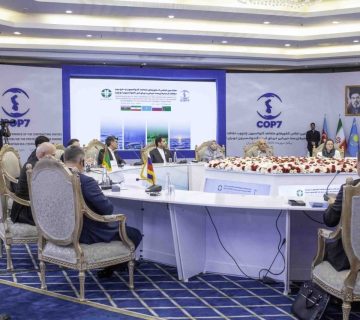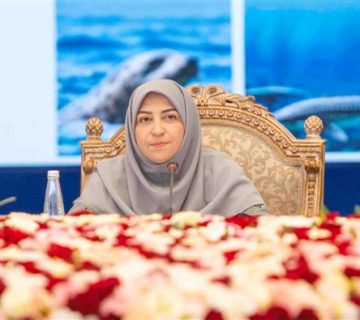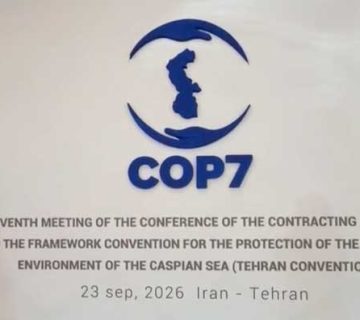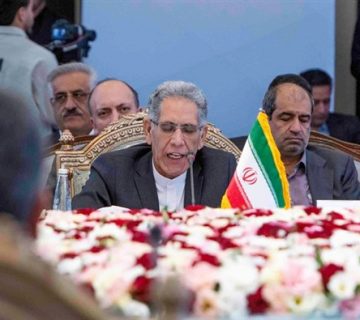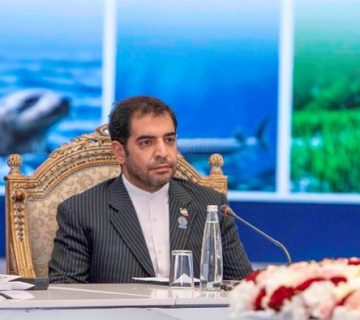
Mehdi Younesi Rostami, Governor of Mazandaran, referring to the hosting of the 7th Conference of the Parties to the Tehran Convention in the Islamic Republic of Iran, emphasized: The future of the Caspian Sea will not be determined within the limits of political borders, but by the quality of cooperation among the five littoral states; today, more than ever, we must move from the stage of dialogue and declaration of commitments to the stage of collective, measurable, and sustainable action.
According to the Public Relations Office of the Department of Environment, the Governor of Mazandaran stated: “Hosting the 7th Tehran Convention summit in the Islamic Republic of Iran is not merely about hosting an international event; this summit is an opportunity for the littoral states to once again view the Caspian as a single ecosystem, a shared asset, and a shared intergenerational responsibility. A sea in which water, natural currents, biological species, pollution, and the consequences of climate change do not recognize political borders cannot be managed with five separate policies and without an effective mechanism for cooperation.”
He added: “Today, the issue of the Caspian is no longer just about protecting a body of water. Declining water levels, shifting coastlines, the vulnerability of wetlands and coastal habitats, pressure on aquatic resources, pollution from watersheds and coastal/marine activities, waste and plastic, and the threat to indicator species such as the Caspian seal simultaneously affect the environment, economy, the livelihoods of coastal communities, ports, fisheries, tourism, and the future development of coastal provinces. Therefore, protecting the Caspian must be elevated from a sectoral environmental issue to one of the pillars of regional development planning.”
Stating that “the Caspian needs the coordinated implementation of existing commitments more than new documents,” Younesi Rostami asserted: “The true value of COP7 must be sought in the days following the summit. The success of this meeting becomes meaningful when its decisions are connected to action plans, specific responsible parties, timelines, evaluation indicators, data exchange systems, and financing mechanisms. The Tehran Convention must gradually transform from a framework for dialogue about the Caspian into an effective architecture for Caspian environmental governance.”
The Governor of Mazandaran continued: “The Islamic Republic of Iran possesses a privileged position to link regional diplomacy with field action, and coastal provinces must play a more prominent role in the implementation phase of the Convention’s decisions. Mazandaran is ready to be one of the pilot sites for implementing joint regional programs in the southern Caspian Sea, because many of the issues being negotiated in Tehran today can be observed and measured concretely on the beaches, wetlands, rivers, and local communities of Mazandaran.”
He said: “In this framework, Mazandaran can become a connection point for national programs and regional cooperation in several areas, including: integrated monitoring of water level and coastline changes, protection and restoration of coastal and wetland ecosystems, participatory monitoring and protection of the Caspian seal, reducing the entry of waste and plastic into the sea, upgrading the management of land-based pollution, and developing joint environmental data and warning systems.”
The Governor of Mazandaran identified the Miankaleh Biosphere Reserve and the Miankaleh-Gorgan Bay wetland complex as areas where the simultaneous effects of climate change, Caspian level fluctuations, habitat changes, and the pressure of human activities are observable, adding: “Such areas can be transformed from ‘vulnerable spots’ into natural laboratories for regional cooperation for the adaptation of ecosystems and coastal communities to Caspian changes; provided that academic knowledge, monitoring data, executive management, local community participation, and financial resources are placed within a unified framework.”
Younesi Rostami also emphasized the necessity of forming a joint knowledge system among the littoral states, stating: “The Caspian cannot be managed with fragmented data and different methods. The development of satellite monitoring, remote sensing, modeling of level and ecosystem changes, standardization of data, and enabling regular information exchange among the five countries must be part of the permanent infrastructure of the Tehran Convention. Joint decision-making does not form without joint knowledge, and joint knowledge does not form without joint data.”
Emphasizing the role of the people, he said: “The future of the Caspian is not determined solely in government meetings. Fishermen, users, local communities, universities, NGOs, economic actors, and the young generation living on the coasts must also be part of the protection system. Sustainable protection happens when the interests of local communities are linked to the health of the ecosystem, and people see themselves not as the subjects of regulations, but as partners in protecting the Caspian.”
The Governor of Mazandaran noted: “For the littoral states, environmental cooperation can become one of the most stable grounds for regional trust-building, transcending the protection of nature. Climate change, pollution, and declining water levels are issues that no country can manage alone, and cooperation to resolve these matters can also strengthen the capacity for dialogue and cooperation in other regional areas.”
Younesi Rostami concluded: “The Caspian is not a heritage that has reached us from the past for us to simply exploit; it is a trust placed in our hands by future generations. Our success is not measured by the number of meetings we hold or documents we sign, but by the state in which we will hand over the Caspian Sea to the next generation. COP7 should be the point from which a new era begins; an era in which five countries protect one sea with shared knowledge, shared responsibility, and collective action. Mazandaran is also ready to play its part and fulfill its responsibility from the front line of this collective action.”